
The economics of dictatorship
A reflection on the dark side of labor markets

Bullets, bullies, and patronage
Bullets and bullies need to be paid for. The Venezuelan string of puppet masters—first Chavez, then Maduro, now Rodriguez—could not have enriched themselves while impoverishing the country without scores of henchmen at their beck and call. But the henchmen need to receive their part of the spoils, or else … After all, it is the goons who hold the guns.
What’s true for Venezuela is true for Iran. The Wall Street Journal reported on March 31, 2026 (p. A6) that according to “recent polls” some 20% of Iranian support the regime and are “a more cohesive bloc than the opposition, binding the ruling Shia clerics, paramilitary forces and civilians through economic interests.” In other words, patronage. No wonder the regime is hard to dislodge. Too many Iranian have a stake in its survival.
Dictatorships—and their 300 million minions
The Economist Intelligence Unit (EIU) scores countries’ level of democracy, or lack thereof, from 0 (worst) to 10 (best). Unsurprisingly, countries like Norway, New Zealand, and Switzerland score high. Others, like Afghanistan, Myanmar, North Korea, Iran, and Venezuela score low.
Unlike Freedom House’s annual ranking of countries, which presents its own judgment to readers—“not free”, “partially free”, and “free”—the EIU leaves it up to readers just where to draw the line. If I were to draw the line at a score up to 3, then the EIU’s 2024 index would convert to 47 countries being dictatorships. The sum total of their populations, using World Bank 2024 data, comes to nearly 1.5 billion people. Take 20% of that and arrive at 300 million people who act as their dictators’ minions, holding the other 1.2 billion people hostage in their own countries, let alone posing serious threats to the rest of the world’s population.
The “Dark Side of the (Labor) Force”
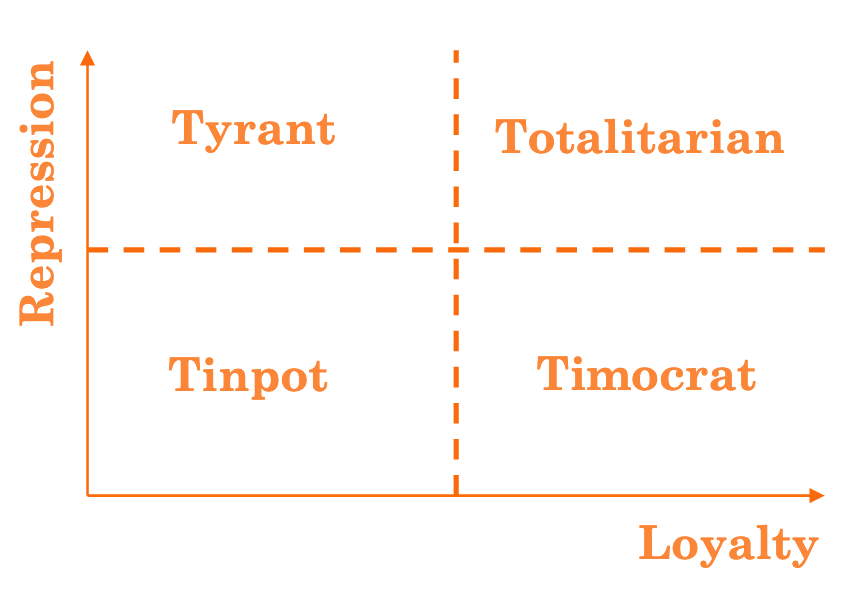
Economists have studied the “Dark Side of the Force” for some time (to use the title of Jack Hirshleifer’s 2001 book on the economics of conflict). I can’t recall if anyone has put specific numbers to the dark side of the labor force required—such as the 300 million “ballpark” number I just generated—but Canadian economist Ronald Wintrobe has produced an interesting book about that labor force’s paymasters, titled The Political Economy of Dictatorship (1998). In it, he differentiates four types of dictatorships along two dimensions: the degree of repression used, and the degree of loyalty sought (and bought).
The idea for differentiation among dictatorships emerges from the two-sided dilemma such regimes face:
The dictator’s dilemma: “The greater the dictator’s power, the more reason he or she has to be afraid.”
The people’s dilemma: “As much as dictators want to be loved, the subjects want them to believe that they are loved, for only then are the people safe from them.”
The dilemmas lead to an associated two-sided commitment problem: The dictator cannot credibly commit not to use repression (he’d rather not give up that option), and the people cannot credibly commit to be loyal (they’d rather not be).
So what is a dictator to do? According to Prof. Wintrobe’s book, the mutual credibility problem can be addressed by using a combination of repression and (bought) loyalty.
Purchasing loyalty
The purchase of loyalty is achieved via patronage payments, a sort of labor market investment by a dictator. In the former USSR, for example, if you were an apparatchik (party functionary), you had access to nice(r) apartments, special shopping rights, occasional overseas travel, access to university education for your children, etc., and one can easily see how this translates to today’s Russia, North Korea, Iran, Venezuela, and other such countries.
Importantly, these patronage payments can be withdrawn and shifted to other favored retainers, loyalists, henchmen, party members, administrators, bureaucrats, & sycophants. The threat of patronage withdrawal is credible and thus likely to keep the dictator’s retinue in line.
This reduces the dictator’s dilemma, and does so also for a just-large-enough percentage of people—the aforementioned 20%—to keep the other 80% of the population in line as the threat of repression now becomes all too credible.
Types of dictatorships
Dictatorships are not all alike. Have a look at the diagram below. A “timocrat”—one who wishes to be loved by the people and uses little or no repression is a “benevolent dictator”. Amusingly, Pope Leo, as head of Vatican City State, falls into this category. Art. 1 of its constitution states that the sovereign power of the Roman pontiff over Vatican City State encompasses all governmental powers, including its legislative, executive, and judicial functions. Yes, read that again: Pope Leo, the dictator.
A tyrant, in contrast, relies far less on love and correspondingly more on buying off the necessary group of thugs needed to lord it over everyone else. This is the world of despots, of the whims of pre-nineteenth century European monarchs and their eventual post-colonial imitators in Africa and Latin America especially.
Tinpot and totalitarian dictatorships are yet other forms of dictatorship. A tinpot dictator uses only that amount of repression necessary to monopolize the economic spoils to be had. Other than that, he leaves people mostly unbothered. They can have families and enjoy their culture as they please; they just can’t threaten political power and the economic benefits accruing to their patron. In contrast, totalitarian regimes aim at “the permanent domination of each single individual in each and every sphere of life” as Hannah Arendt put it in her The Origins of Totalitarism book (1951). Tyrants and tinpot dictators don’t much care about people’s minds. Totalitarians do: Hitler, Stalin, and various Ayatollahs come to mind.
Type-shifting dictatorships
Readers can fill in the diagram below with their own historical or contemporary examples. To indicate that the four categories are not absolutes but that movement between types is possible, I show this diagram in my teaching with dashed vertical and horizontal lines—rather than with Wintrobe’s original solid lines.
Venezuela’s Chavez, Maduro, and now Rodrigues, were/are steady tinpot dictators. Iran is different, however. Since the Shah’s fall nearly 50 years ago its regime has morphed from timocracy to totalitarianism to occasional tyranny. The hatred of the former Shah was widespread, and initially at least Ayatollah Khomeini’s Iranian Revolution might well be said to have attracted “love” with little need for repression. But since 1979, two generations of youngsters have been born. They have no personal knowledge of the preceding regime. Evaluating their own conditions, the young by and large don’t like what they’ve got. Over time, the regime thus turned more totalitarian, and even tyrannical on an “as needed” basis to bloodily repress any uprisings.
It seems to me that totalitarian regimes are harder to overthrow than tinpot regimes, by insiders or by outsiders. This is because, relative to tinpot countries, totalitarian countries rely on a numerically large class of “ordinary” loyalists who each have too much to loose and thus fight to keep the regime and their own share of the spoils going. Such regimes, like World War II Imperial Japan and Nazi Germany, may possibly only be defeated through similarly drastic warfare, which is an unsettling prospect to consider.
If you found this post of interest, please tap the Share button below.
And why not also tap the Subscribe Now button below? Subscription is free-of-charge for my Monday posts. If you wish to support my work monetarily, you’ll receive an additional post each Thursday and have access to my post archive.